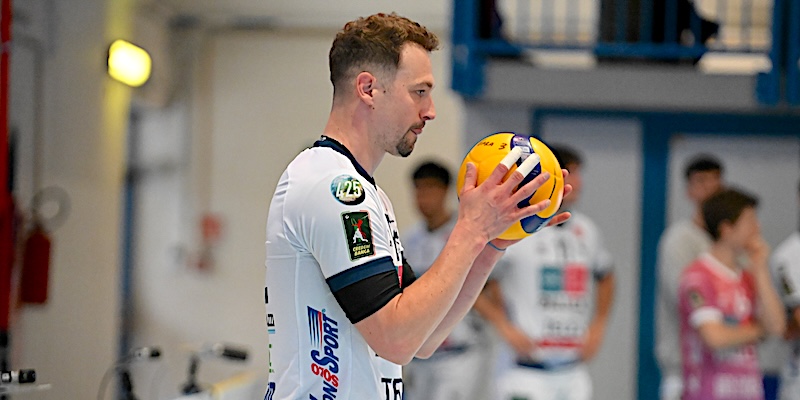
Champions aren’t just recognized by numbers. Sometimes they shine through in the less visible details: a poor reception transformed into balance, a word spoken to a teammate at the right time, a willingness to adapt without ever putting oneself before the rest. From this perspective, Alexander Berger is much more than a top-tier spiker loaned to Serie A3. He’s a role model. Technically, of course. And human.
EXPERIENCE – At the most delicate moment of the season, Belluno Volley is also relying on the Austrian’s experience and personality ahead of Game 3 of the playoff final against Domotek Reggio Calabria, scheduled for Sunday, May 17 (7:00 PM) at Pala Calafiore. This match is worth promoting to Serie A2. And Berger is getting there after a difficult few weeks. Physical problems limited his consistency and brilliance, preventing him from consistently expressing the level of volleyball that, throughout his career, led him to win a Scudetto and two Coppa Italia titles with Perugia, as well as competing regularly with Europe’s elite. “It was a very tough month for me, which is why I’m happy with my performance in Game 2,” he said. “And that I was able to lend a hand to the team. I really wanted to.”
SERVING THE GROUP – Even when his body didn’t allow him to be as dominant as at other times, Alex never stopped being useful. He was there. Without excuses, without dramatic gestures, without ever shying away. This is probably the most authentic trait of his journey in the white-and-blue jersey: the humility with which he chose to put himself at the service of the group. Always. Even on days when it would have been easier to manage himself, to take a breather. Instead, Berger continued to work in silence. Providing quality in decisive moments, experience in the most tense situations, and serenity in the locker room.
PACE – And as the champion he is, he responded at the right moment, making an impact with the technical precision and clarity that only top-level players possess. Those who understand the weight of each ball and know when to accelerate, when to slow down, when to take on extra responsibility: “What’s changed? Simply, I’ve found my rhythm again. And that was crucial, because my last “real” match was over a month ago. But we had a do-or-die match ahead of us: we couldn’t make any mistakes. In short, we’re happy to have extended the series. And one of the keys was our patience.”